

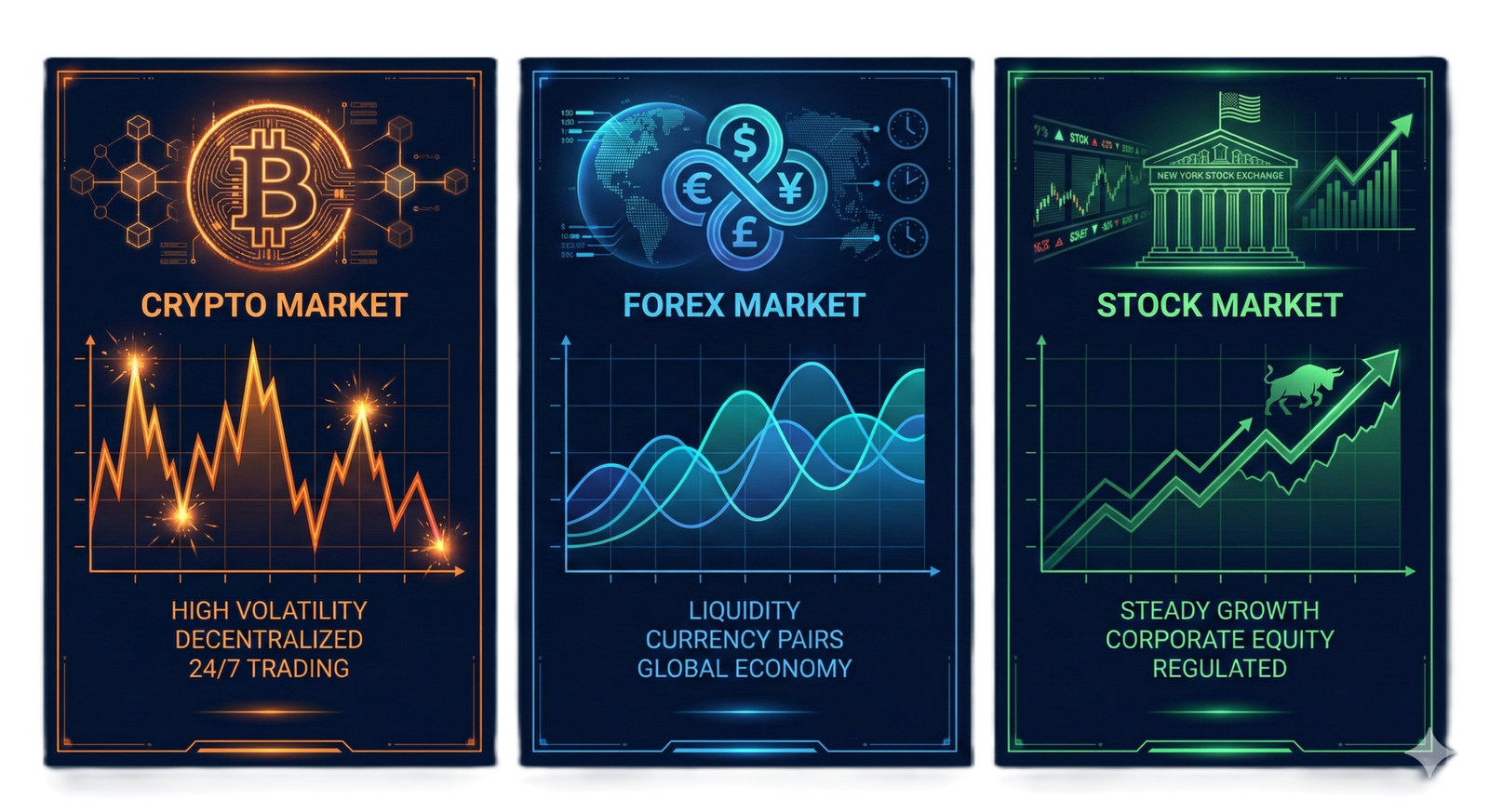
For years, the financial world was divided by a clear border. On one side stood traditional finance (TradFi), with its legacy stock brokers and foreign exchange (Forex) platforms. On the other was the fast-paced, 24/7 world of cryptocurrency exchanges.
Recently, however, this border has rapidly blurred. Major cryptocurrency platforms are actively integrating traditional stock trading and Forex pairs into their dashboards. This evolution is transforming crypto exchanges from niche digital-asset shops into comprehensive financial super-apps.
Here is an analysis of the core drivers behind this massive convergence.
1. Capital Retention During Crypto Winters
The cryptocurrency market is notoriously cyclical, defined by aggressive bull runs and prolonged corrections (crypto winters). When the crypto market cools down, retail trading volume drops drastically, hurting the exchange’s main revenue stream: transaction fees.
By introducing stable, high-liquidity assets like Apple stock or EUR/USD pairs, crypto exchanges build a powerful hedge against their own volatility. When digital assets enter a bear market, users do not need to cash out and move their funds back to a legacy bank. They can seamlessly rotate their capital into traditional equities or foreign currencies right within the same app, keeping liquidity inside the exchange’s ecosystem.
2. The Rise of Tokenized Real-World Assets (RWAs)
The technical infrastructure of crypto has matured. Blockchain technology is no longer just for native tokens like Bitcoin; it is increasingly used to wrap traditional assets into “Tokenized Real-World Assets” (RWAs).
Using stablecoins and smart contracts, exchanges can now offer fractional shares of blue-chip US stocks or tokenized fiat currency pairs. This allows global users—even those in emerging economies—to trade high-value assets like Nvidia or Tesla without needing a US brokerage account, minimum balance requirements, or expensive international wire fees.
3. Capturing the “All-in-One” Super-App Trend
Modern retail traders, particularly Gen Z and Millennials, value maximum convenience. They are exhausted by fragmented user experiences—having one app for crypto, another for stock portfolios, and a third for tracking fiat exchange rates.
Crypto exchanges are capitalizing on this fatigue by building financial super-apps. Providing a single KYC (Know Your Customer) process, unified collateral (using Bitcoin or stablecoins to back Forex margin positions), and a single interface creates immense user stickiness.
4. Intense Competition and Fee Compression
As the crypto exchange market has become saturated, trading fees for spot cryptocurrency pairs have compressed significantly. Exchanges can no longer survive solely on the margins of basic retail crypto trading.
Expanding into Forex (the largest, most liquid financial market in the world) and equities opens up massive new monetization channels. It allows platforms to offer advanced financial products such as:
High-leverage margin trading on stable currency pairs.
Derivative contracts linked to global stock indices.
Cross-asset yield products.
5. Regulatory Maturation and Institutional Trust
In the past, traditional financial institutions viewed crypto platforms as high-risk environments. However, the introduction of spot Bitcoin and Ethereum ETFs, alongside stricter global regulatory frameworks, has standardized the industry.
As crypto exchanges adopt institutional-grade compliance, security, and custody practices, it becomes much easier for them to secure licenses or partner with traditional liquidity providers. Merging TradFi instruments into a crypto interface is a natural next step once the regulatory gap between the two worlds is bridged.